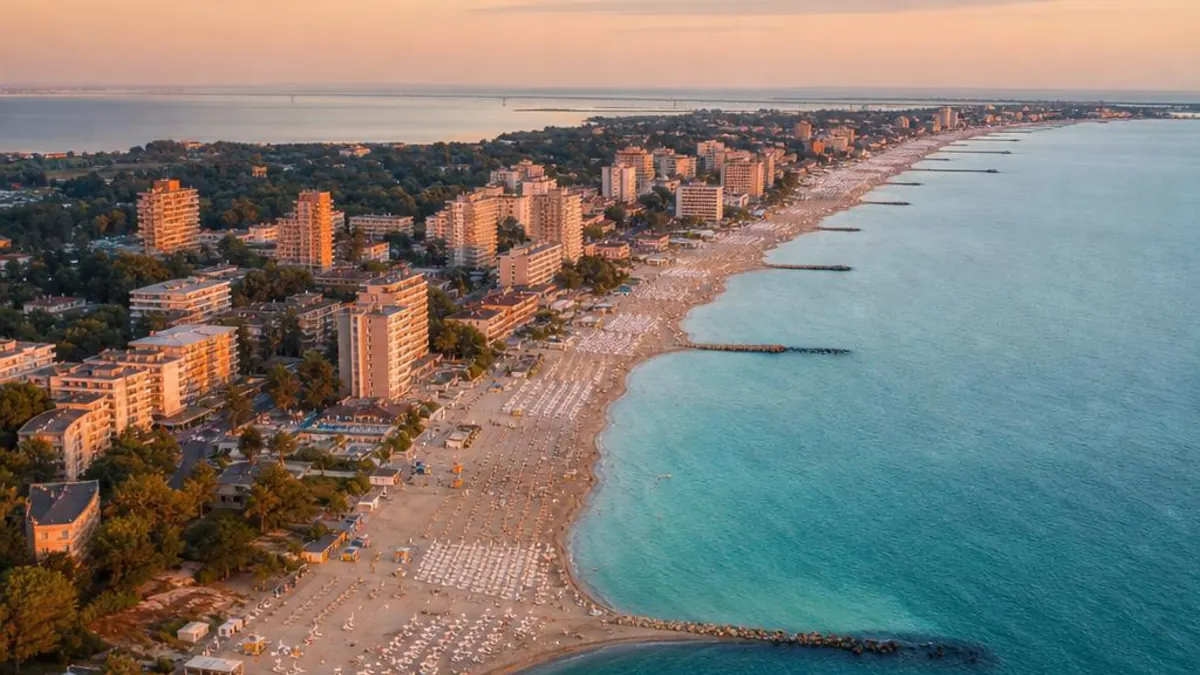
Summer 2026 was a season of contrasts for Romanian tourism. After a first half with declines almost every month, July brought the first increase of the year, and the Black Sea coast went from half-empty beaches in mid-summer to weekends at 100% occupancy. We pieced together data from Romania's National Institute of Statistics (INS), reports from the ground and European indicators to see what changed and what it means for short-term rental hosts (regim hotelier).
INS data month by month: a year that started in the red
INS publishes monthly arrivals and overnight stays in tourist accommodation establishments, including rented apartments and rooms. The 2026 series shows a weak start to the year and a recovery only in mid-summer.
| Period (vs 2025) | Arrivals | Overnight stays |
|---|---|---|
| January | −7.3% | −8.5% |
| February | −3.7% | −3.0% |
| April | −7% (813,600 arrivals) | −11.6% (1.516 million) |
| May | +0.1% | −4.3% |
| June | −2.5% | −5.7% |
| July | +6.2% | +6.1% |
| January–May (cumulative) | −4.5% (4.287 million) | −7% |
| January–July (cumulative) | −1.6% (7.487 million) | −3.1% (15.543 million) |
Two things stand out. First, overnight stays fell faster than arrivals, so tourists stayed for shorter periods. In the first five months, the average length of stay was 1.8 days for Romanian tourists and 2.1 days for foreign visitors. Second, the July increase was not enough to offset the earlier declines, and the balance for the first seven months remains negative.
About the August data. INS published its August figures on 7 October 2026, in the press releases on insse.ro. This analysis uses the series up to July, the latest month we could verify across several sources.
Who travels: Romanians dominate, foreigners stay longer
Romanian tourists remain the engine of the market. In January–May they accounted for 78.6% of arrivals and 76.2% of overnight stays. In summer their share grows even further: in July, 86.5% of overnight stays came from Romanian tourists. Across the first seven months, the split was 79.9% to 20.1%.
The difference came from how the two groups evolved. In the first quarter, overnight stays by Romanian tourists fell by 12.2% in January, 4.9% in February and 10.9% in March, while those by foreign tourists rose by 7.9% in January and 5% in February, with a slight 1.1% dip in March (Forbes Romania). In the first half of the year, most foreign tourists came from Germany (114,800), Italy (105,700) and the United States (78,800). We look at these markets in detail in our analysis of foreign tourists.
The drop in domestic demand comes down to household budgets. According to INS, annual inflation was 6.2% in August, and consumption fell in July for the fourth month in a row. On top of that, holiday vouchers for public-sector employees were cut from 1,450 to 800 lei. Their effect is analysed in our article on holiday vouchers.
The coast: frozen prices, then full weekends
On the coast, the summer had two faces. On 25 July, Euronews Romania reported, citing operators, that tourist numbers were more than 20% below the previous summer and occupancy stood at 60–70%, even though 15 July–15 August is the peak of the season. It was the first year in which accommodation rates did not rise in high season; in previous years, July brought price increases of 10–20%. Instead of raising prices, hoteliers offered free nights (pay for four, stay five), included sun loungers and parking, and some all-inclusive hotels offered free accommodation and meals for children up to 12.
Cristian Bărhălescu, president of the National Association of Travel Agencies (ANAT), explained that when demand is subdued, hoteliers consider filling rooms more important than raising prices. Two weeks later the picture was different: on 8 August, according to a tourism association quoted by the Agerpres news agency, the coast had reached 100% occupancy that weekend, with more than 200,000 tourists.
Supply grew alongside the pressure on demand. According to Radio Romania International, the number of classified accommodation units on the coast rose by almost 10% in 2026, to almost 5,400. More supply and more cautious domestic demand mean price competition, especially on weekdays and at the edges of the season.
Those who did choose the coast spent more per stay. According to the travel agency EXIMTUR, its customers paid an average of €768 per room for a holiday on the Romanian coast, 7% more than last year, driven by demand for all-inclusive packages, and €475 per room for other destinations in the country (also +7%). Eforie Nord saw demand rise by 16%. For short-term rental apartments, Crosspoint Research shows that in 2025 Constanța had the longest average stay among major cities, at 6.5 days, and the average daily rate (ADR) in August was €103.8. What these figures mean for the value of an apartment is covered in our valuation guide for Constanța and Mamaia.
Mountains and cities: day trips and city breaks
In the mountains, operators reported fewer overnight stays and more day trips in the first half of the year and over the summer (Business24, 31 August 2026). For hosts, this means shorter stays and stronger competition for weekends. Among cities, Bucharest remains the leading destination: it recorded about 557,300 arrivals in January–April, followed by Brașov. In the short-term rental market, Crosspoint Research reports for Bucharest in 2025 revenue of €66.8 million (+20%), 2.06 million tourists, of whom 1.1 million were foreign, and September as the peak month.
The European context: platform demand is growing
Across the European Union the trend is different. According to Eurostat, 951.6 million nights in short-stay accommodation were booked through Airbnb, Booking and Expedia in 2025, 11.4% more than in 2024 and 32.4% more than in 2023. The last quarter of 2025 alone accounted for 172.3 million nights (+10.9%). The data suggests that in Romania, the 2026 problem lies mainly in the purchasing power of Romanian tourists, not in interest in this type of accommodation.
What it means for hosts: 6 adjustments for next season
- Treat the peak as a short window. Weekends and mid-August filled up; weekdays did not. Use day-by-day pricing rather than a single rate for the whole summer.
- Don't raise prices by reflex. In a year of subdued demand, even large hoteliers chose occupancy over price increases. Compare yourself with the supply in your area before changing your rates.
- Diversify your markets. Foreign tourists supported the first months of the year. A listing properly translated into English, German or Italian and clear rules for longer stays can help you attract this segment.
- Prepare the off-season early. The school autumn holiday (24 October–1 November), Romania's National Day on 1 December and the winter holidays are windows of domestic demand. The full calendar is in our cold-season pricing guide.
- Stand out in a market with more supply. With almost 10% more classified units on the coast, reviews, photos and compliance become selling points.
- Track costs, not just revenue. With flat rates and rising costs, margins can erode; see our analysis of costs and margins.
Common mistakes when reading the data
- Comparing only your own bookings with last year's. Without knowing how supply and demand evolved in your area, you cannot tell whether you lost or gained ground.
- Treating national figures as a forecast for your property. INS data is aggregated; demand can vary widely from one resort or neighbourhood to another.
- Ignoring length of stay. The national average is about two days, but stays on the coast are longer. Minimum-stay settings should be adapted to your market.
Frequently asked questions
Did tourism in Romania grow in 2026?
It depends on the period. In July 2026, arrivals rose by 6.2% and overnight stays by 6.1% compared with July 2025, the first increase this year. The balance for the first seven months remains negative, however, after the declines of the first half.
Where can I find the latest INS tourism data?
INS publishes monthly press releases on arrivals and overnight stays in tourist accommodation establishments on insse.ro, and the detailed series are in the TEMPO-Online database. The August 2026 data was published on 7 October.
Where do most foreign tourists come from?
In the first half of 2026, most foreign tourists staying in tourist accommodation establishments came from Germany (114,800), Italy (105,700) and the United States (78,800).
Is it still worth investing in a short-term rental on the coast?
The coast has longer stays and high rates in August, but the season is short and supply has grown. The decision should be based on the figures of the specific property, with cautious scenarios; the steps are in our coastal valuation guide.
Sources
- INS – Tourism press releases (in Romanian)
- INS – Tourism in January 2026 (PDF, in Romanian)
- Economica.net – How tourism evolved in the first two months of 2026 (in Romanian)
- Forbes Romania – The tourism industry slows down in early 2026 (8 May 2026, in Romanian)
- Digi24 – INS: overnight stays down 8% in the first four months (in Romanian)
- Știrile ProTV – The places in Romania that draw the most tourists (4 June 2026, in Romanian)
- Economedia – Romanian tourism down in the first five months of 2026 (3 July 2026, in Romanian)
- Agerpres – INS: arrivals and overnight stays down 2.5% and 5.7% in June 2026 (6 August 2026, in Romanian)
- Termene.ro – INS: arrivals and overnight stays up 6.2% in July, but down after seven months (in Romanian)
- Digi24 – INS: more tourists in July, but the seven-month balance remains negative (in Romanian)
- Agerpres – Tourist arrivals and overnight stays in Romania up by more than 6% in July 2026 (4 September 2026)
- Euronews Romania – The summer the Romanian coast gave up price rises (25 July 2026, in Romanian)
- Agerpres – Over 200,000 tourists on the coast (8 August 2026, in Romanian)
- Radio Romania International – Information from the Romanian Black Sea coast (13 August 2026, in Romanian)
- Agerpres (EXIMTUR press release) – How tourists' preferences changed in 2026 (in Romanian)
- Știrile ProTV – Household consumption drops sharply in July, fourth month of decline (25 September 2026, in Romanian)
- Business24 – Mountain tourism in Romania under pressure: fewer overnight stays and more day trips (31 August 2026, in Romanian)
- Eurostat – Tourism nights booked via platforms hit nearly 1 billion (1 April 2026)
- Crosspoint Research (Savills associate) – Romania Short-Term Rental Market 2025