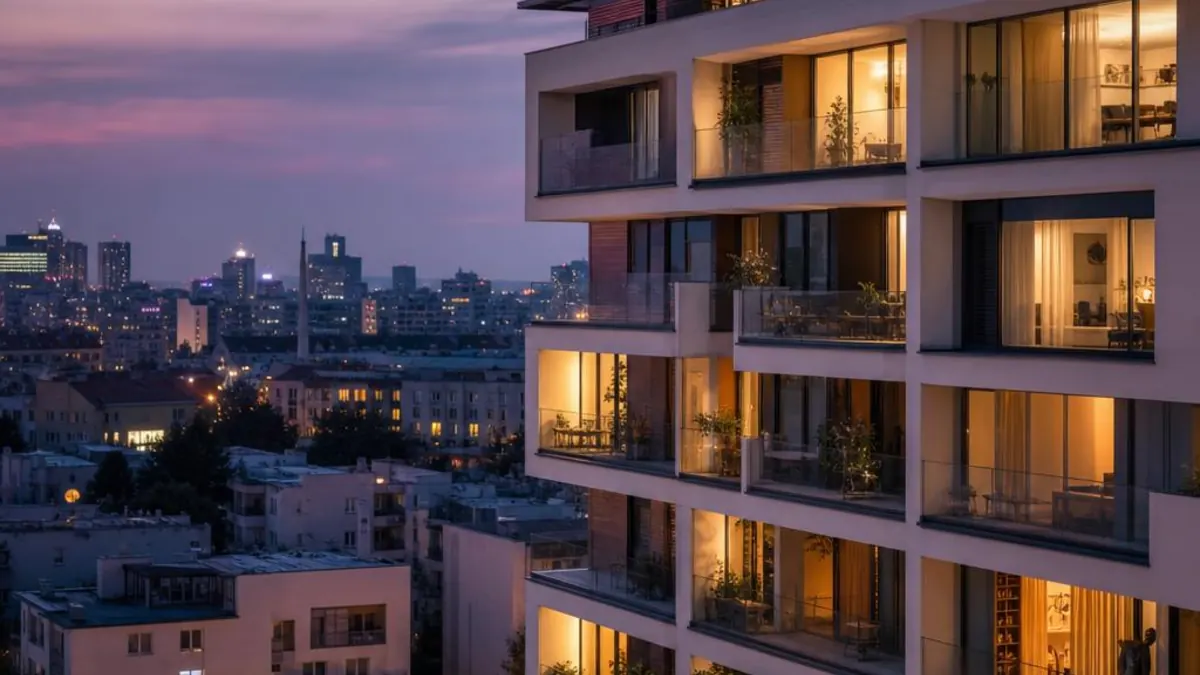
In Bucharest, many short-term rental portfolios are built one studio at a time: the takings from the first units help pay for the next one, and the rules stay the same up to a point. That point is the eighth room. Order No. 948/2026 allows an individual to classify at most 7 rooms and 14 places, and above 7 rooms let short term, all income moves to independent activities, with CAS (the pension contribution) and a much higher CASS (health contribution). The case study below follows an illustrative investor from the first studio to the eighth: the systems introduced along the way, how seismic risk is checked before every purchase and why the eighth studio ended up, once the numbers were run, with a long-term tenant.
Illustrative, composite case study. The investor and the studios do not exist: the case combines situations common in Bucharest and uses the cost structure from our comparison of Bucharest, Cluj-Napoca and Brașov. The public benchmarks are the Crosspoint Research report on 2025, VDI.ro data, MEDAT Order No. 948/2026, the 2026 tax rules published by ANAF, KPMG’s 2026 tax guide, Law No. 212/2022 and Bucharest General Council Decision No. 516/2025. All assumptions are stated openly, so you can replace them with your own figures. The calculation is no substitute for advice from an accountant.
Starting point: 7 studios, 7 rooms, 14 places
The investor works full time and bought the first studio for short-term letting a few years ago. Takings and savings went back into the portfolio, and by 2026 it had grown to 7 studios in several of Bucharest’s sectors, all classified in the investor’s name and let through Airbnb. Each has one room with a double bed, so two places. At today’s prices, a similar studio costs around €69,500, the median asking price in Bucharest (VDI.ro), plus about €8,000 for furnishing, equipment, the notary and land registration. The 7 studios are therefore worth around €542,500.
In 2026, the investor decided to buy an eighth. Before signing, two checks were made, and this case study follows both: the building’s seismic risk, and what changes, for classification and for tax, when the portfolio goes beyond 7 rooms. The calculation compares the options over a full year, under the 2026 rules.
The limit is counted in rooms and places, not apartments. Order No. 948/2026 states that individuals may apply for classification for at most 7 rooms and 14 places, in apartments and rooms for rent in privately owned homes, “regardless of the number of homes in which they are located”. Above that limit, according to Airbnb, you must operate as a PFA sole trader, an individual or family enterprise, or a company. With 7 studios of two places each, the investor had no margin left: a sofa bed declared as an extra place, in just one studio, would have brought the total to 15 places. The details are in our guide to Order No. 948/2026.
Shared assumptions. We applied the 2026 rules. Each studio takes €10,000 a year, from about 200 nights at €50 a night. This is a cautious assumption: for Bucharest, Crosspoint Research reports an average nightly rate of €56.5 in 2025, an occupancy rate of 62% and average takings of €1,006 a month per property, and the average also includes larger apartments. Airbnb’s single fee is 15.5%, and for a host not registered for VAT, 21% VAT is added on top, so about 18.8% of takings. For each studio, cleaning, laundry and consumables cost 15% of takings; utilities, internet, building maintenance fees and the PMS (property management system) subscription €1,800 a year; and building tax, insurance and repairs €600 a year. CASS is calculated as if the rentals were the investor’s only non-salary income. Bucharest’s tourist tax is paid by the guest. ECB exchange rate of 9 October 2026: €1 = 5.3406 lei.
How the portfolio grew: one problem, one system
The investor did not start out with a plan for 7 units. A new system came in only when the same problem had come up several times. The table below summarises the stages.
| Stage | What became difficult | What the investor introduced |
|---|---|---|
| 1 studio | messages, keys and cleaning, all done in person, in the evenings and at weekends | a key lockbox with a code, template check-in messages and a cleaning checklist |
| 2–3 studios | cleaning on days with several check-outs and check-ins | a partner cleaning company, with a per-stay rate, rotating linen and photos sent after every clean |
| 4–5 studios | calendars, repetitive messages and the prices of each listing | a PMS, with a single calendar for all listings, scheduled messages and pricing rules by day and season |
| 6–7 studios | restocking, minor repairs and the records for each room | a central stock of consumables, a trusted plumber and electrician, a monthly routine for tax documents |
Three choices mattered more than the rest. The first was the single calendar. With 7 listings, a double booking or a forgotten clean is no longer an accident but a matter of time, and the PMS brought calendars, messages and the cleaning schedule into one place. If the investor adds other platforms, the same system syncs calendars between them. Hosts connected to Airbnb through such a system were moved to the 15.5% single fee as early as 27 October 2025, so the new fee came as no surprise in the investor’s calculations.
The second was a pricing routine. Once a week, the investor compares rates for the next four weeks with the prices by area in KeyBid Puls for Bucharest and adjusts the benchmarks in the PMS. Demand peaks in autumn: according to Crosspoint Research, September was Bucharest’s best month in 2025.
The third was record-keeping. For each room, the investor completes and keeps the accommodation occupancy form (ANAF Order No. 381/2026), with the guest’s name, personal numeric code (CNP) or, if there is none, the series and number of the ID document, and the dates of the stay. Takings go into the tax record register. With 7 studios, that means a few hundred stays a year, and the monthly routine saves a week of searching before the deadline for the single tax return, 25 May.
Seismic risk, checked before every purchase
In Bucharest, the first question about a new studio is not the yield but the building. Law No. 212/2022, as amended by Law No. 426/2023, bans renting out space in buildings rated seismic risk class I (RsI). According to The Guardian, the ban has applied since 2024 to both short-term and long-term lets, so a conventional tenancy is no fallback. Fines can reach 10,000 lei, according to Profit.ro.
In summer 2026, enforcement became visible. An analysis published by The Guardian on 16 July 2026 counted at least 207 homes let to tourists in RsI buildings in Bucharest at the end of May. On 19 August 2026, the professional association ATIP announced, according to Profit.ro, that Airbnb was checking listings and that notified owners had 14 days to prove that their property was not rated class I.
The investor’s routine has three steps. The first is a land register extract for information, which costs 20 lei on ANCPI’s ePay platform, because that is where the seismic risk class is recorded. The second is a question for the owners’ association: has the block had a technical assessment, when and with what result? The third is a look at the local authorities’ public lists. An extract with no entry does not automatically mean a safe building, because the block may never have been assessed, so the question for the association is still a must.
For the eighth studio, the investor had three candidates, found by filtering listings with the KeyBid ROI Calculator extension, which shows an estimated yield and a colour-coded label on Storia, Imobiliare.ro and OLX but does not check seismic risk or the 7-room limit. The cheapest, in an old block in the centre, had the best estimated yield. The land register extract, however, showed a class I rating, so the studio could not be let at all, either short term or long term. The investor bought one of the other two, in a new block with no seismic risk entry in the extract. What to do if you receive a notification and how to check a building step by step are covered in our guide to seismic risk.
The 7-room threshold: what an eighth studio let short term would have changed
Two things change at once with the eighth studio. The first is classification: as an individual, the investor cannot classify an eighth room, so a PFA, an individual or family enterprise, or a company would have been needed. Letting short term without classification is not an option: Government Decision No. 1267/2010 sets a fine of 40,000–50,000 lei for it.
The second is tax. Article 68(4) of the Tax Code, as amended by Law No. 239/2025, provides that from the tax year in which more than 7 rooms are let short term, the income becomes income from independent activities. That means all of it, not just the income from the eighth studio. The flat-rate system stays the same: net income is 70% of the takings left after the platform commission, and income tax is 10%. The contributions change. CAS of 25% comes in, mandatory from net income of 12 minimum wages, on a base of at least 24 minimum wages once net income exceeds that amount. CASS of 10% is capped at 72 minimum wages instead of 24.
| Lei a year | 7 studios, as an individual | 8 studios, independent activity (PFA) |
|---|---|---|
| Takings left after the platform commission | 303,728 | 347,118 |
| Flat-rate net income (70%) | 212,610 | 242,982 |
| Income tax (10%) | 21,261 | 24,298 |
| CAS (25% of 24 minimum wages) | – | 24,300 |
| CASS (10%) | 9,720 (the 24-minimum-wage cap) | 24,298 |
| Total tax and contributions | 30,981 | 72,896 |
| Total in euros | 5,801 | 13,649 |
Of the extra 41,915 lei, 24,300 lei is CAS, 14,578 lei is additional CASS and 3,037 lei is income tax on the eighth studio’s income. In euros, the difference is €7,848. Before tax, the eighth studio would have brought in €4,225: the €10,000 in takings, minus Airbnb’s fee, cleaning, utilities and fixed costs. The upshot: with an eighth studio let short term, the portfolio would have earned €3,623 a year less than with only 7 studios, before counting the cost of bookkeeping for the PFA and any VAT.
CAS is not money lost: it counts towards your pension contribution record. For an investor who wants income now, however, those 24,300 lei a year no longer end up in their pocket. The exact calculation also depends on other income and on each person’s tax choices, so the figures above are a starting point for a conversation with an accountant, not a ready-made tax return.
VAT: a second threshold, very close to the first
Since 1 September 2025, the VAT exemption threshold for small businesses has been 395,000 lei a year. Exceeding it means you must apply for VAT registration, and accommodation is taxed at the reduced rate of 11%. The 7 studios take €70,000, or about 373,800 lei: below the threshold, but not by much, since an increase in takings of about 6% would cross it. With eight studios let short term, takings would have reached about 427,200 lei, above the threshold. Airbnb also points out that prices raised to cover the new fee increase gross income and can bring you closer to the registration threshold.
Our calculation does not include VAT. Had the investor become VAT-registered without being able to raise prices, part of every night sold would have gone to the state, and the option with eight studios let short term would have come out even weaker. So track your takings monthly, together with your accountant, and find out in advance from what point the obligation would apply.
Four options for eight studios
With all the figures on the table, the investor compared three options for an eight-studio portfolio and set them alongside the starting position.
| Option (€ a year) | Gross takings | Result before tax | Tax and contributions | Net result |
|---|---|---|---|---|
| 7 let short term, the eighth let long term | 74,070 | 33,041 | 6,127 | 26,914 |
| All 8 let short term, through a PFA | 80,000 | 33,796 | 13,649 | 20,147 |
| All 8 let long term | 32,560 | 27,760 | 4,425 | 23,335 |
| Benchmark: only the 7 let short term | 70,000 | 29,571 | 5,801 | 23,770 |
The mixed option comes out best, at €26,914 a year, or 4.3% of the current value of the eight studios, about €620,000. The eighth studio, let at €370 a month, the median asking rent for a studio in Bucharest (VDI.ro), brings in €3,144 net, after 11 months of rent, €600 in fixed costs and income tax of 10% on 80% of the rent. It adds no CASS, because rental income had already passed the 24-minimum-wage cap, and it does not count towards the 7-room limit, which concerns short-term letting.
The PFA option comes out worst, below the starting position, despite taking €10,000 more. The comparison with the option in which all the studios are let long term shows why. On our figures, the advantage of short-term letting over a long-term let is about €3,579 a year for the 7 studios. Crossing the threshold alone, through CAS and the higher CASS on the 7 studios’ income, would have cost 35,841 lei, or about €6,711, more than that entire advantage.
The conclusion depends on this portfolio’s figures. With much higher takings per unit, a much larger portfolio or a different legal structure, the result can change, but the calculation has to be redone from scratch, not assumed. How short-term letting compares with a long-term let in three major cities is shown in our yield analysis for Bucharest, Cluj-Napoca and Brașov.
Why not an SRL, for now
The accountant also prepared a simulation for an SRL (limited liability company). As a micro-enterprise, a company pays tax of 1% of revenue from 1 January 2026, but the conditions matter: at least one full-time employee, turnover of at most €100,000 (the 2026 threshold) and at most one micro-enterprise per shareholder holding more than 25%. Money taken out of the company as dividends is taxed at 16%, and if the company no longer meets the conditions, it moves to 16% corporate income tax from that quarter (KPMG).
For this investor, the problem was a different one: the studios are in the investor’s name, not the company’s. Moving them into the company or renting them to the company has its own legal and tax consequences, and the mandatory employee adds a fixed cost. At eight studios, the investor preferred the mixed option, which is simpler and adds no new costs. The SRL simulation stays on the table for when the portfolio grows well beyond eight units. What each legal structure involves and which systems help at 8–10 units is covered in our guide to scaling a portfolio from 1 to 10 properties.
Bucharest’s tourist tax, multiplied by seven
Since 2026, Bucharest has charged a fixed tax of 10 lei per tourist per night, replacing the 2025 tax of 2% of the rate (HCGMB No. 516/2025). The tax applies to all accommodation, including apartments, whether classified or not. The decision provides that when a platform such as Booking or Airbnb collects the payment, the platform also collects the tax. Otherwise, the accommodation unit collects the tax, files a tax return with its sector’s local tax office and pays the amount by the 10th of the month after the stay ends. A draft amendment, put to public consultation in August 2026, would keep the 10 lei but would leave collection to the accommodation unit and introduce some exemptions. Check the version in force and whether the platform actually collects the tax for your listings. If you have studios in several sectors, ask each sector’s tax office which returns you need to file.
The amount is not small. For a studio with 200 nights a year and two guests a night, the tax comes to 4,000 lei, about €749. Across 7 studios, that means up to 28,000 lei a year, about €5,243. Agree from the start who collects the tax for each booking channel. If you end up paying it out of the accommodation price, with 7 studios you can lose more than the whole advantage of short-term letting over a long-term let in the calculation above.
What you can take from this case
- Count the rooms and places across all your homes before you buy the next unit, including sofa beds declared as places.
- Before you go beyond 7 rooms, calculate tax and contributions for the whole portfolio, not just for the new unit.
- Include the mixed option in your calculation: short-term letting up to the limit, a long-term let after that.
- Track your takings monthly against the VAT exemption threshold of 395,000 lei.
- Request the land register extract before any offer: in seismic risk class I, you cannot let at all.
- Introduce a system when a problem repeats itself: a cleaning partner, a single calendar, a central stock, monthly records.
Common mistakes
- Counting apartments rather than rooms and places. The limit of 7 rooms and 14 places adds up across all your homes, and a sofa bed declared as a place can become the 15th.
- Calculating the tax on the new unit only. Above 7 rooms let short term, all income moves to independent activities, with CAS of 24,300 lei and a CASS capped only at 72 minimum wages.
- Letting an eighth room short term “just for a few weeks”. The threshold applies per tax year, so even a few weeks can change the regime for the whole year, and without classification you risk a fine of 40,000–50,000 lei.
- Forgetting the VAT threshold. With 7 studios like these, you are close to 395,000 lei a year, and an increase in takings of around 6% can take you over it.
- Buying without a land register extract. It costs 20 lei online, and in a seismic risk class I building you cannot let even long term.
- Paying the tourist tax out of the accommodation price. With 7 studios, 10 lei per tourist per night can add up to more than €5,000 a year.
- Growing before you have systems. Every missed check-in or unsynced calendar repeats itself across all your units.
Frequently asked questions
How many apartments can I let short term as an individual?
Order No. 948/2026 does not limit the number of apartments but the rooms and places: at most 7 rooms and 14 places, added up across all your homes. With studios of two places each, that means at most 7 studios. Above the limit, you need a PFA, an individual or family enterprise, or a company.
What changes in tax if I go beyond 7 rooms?
From the tax year in which you let more than 7 rooms short term, all income becomes income from independent activities. Income tax stays at 10% of flat-rate net income, but you pay CAS of 25% from net income of 12 minimum wages, and CASS is capped at 72 minimum wages instead of 24. In our example, tax and contributions rise by 41,915 lei a year. The step-by-step calculation for 1–7 rooms is in the tax guide for short-term rentals.
Can I let an apartment in a red-dot building on a long-term lease?
No. Law No. 212/2022, as amended by Law No. 426/2023, bans renting out space in buildings rated seismic risk class I, and according to The Guardian, the ban has also applied to long-term lets since 2024. Check the land register extract before making an offer and ask the owners’ association about the technical assessment.
Is an SRL worth it for a short-term rental portfolio?
It depends on the figures. The 1% tax on revenue for micro-enterprises comes with conditions, including a full-time employee and turnover of at most €100,000, and dividends are taxed at 16%. If the apartments are in your name, how the company comes to use them also matters. Ask an accountant for a simulation for a PFA and for an SRL, based on your own takings.
Sources
- MEDAT Order No. 948/2026 – Romanian Legislative Portal (in Romanian)
- Airbnb – Responsible hosting in Romania
- VDI.ro – Bucharest property indices (11 October 2026, in Romanian)
- Crosspoint Research (Savills associate) – Romania Short-Term Rental Market 2025
- Airbnb – Simplifying service fees on Airbnb (7 July 2026, updated 24 August 2026)
- Guesty Help Center – Understanding Airbnb service fees for hosts and guests
- Airbnb Help Center – Value Added Tax (VAT) and how it applies to you
- ANAF – Accommodation occupancy form, ANAF Order No. 381/2026 (PDF, in Romanian)
- Law No. 212/2022 – Romanian Legislative Portal (in Romanian)
- Law No. 426/2023 – Romanian Legislative Portal (in Romanian)
- The Guardian – Bucharest tourists hiring rentals that could collapse in an earthquake (16 July 2026)
- Profit.ro – Airbnb begins clean-up in Romania: apartments in red-dot buildings risk removal (19 August 2026, in Romanian)
- ANCPI ePay – Land register extract for information (in Romanian)
- Government Decision No. 1267/2010 – Romanian Legislative Portal (in Romanian)
- ANAF – Tax treatment of income from renting 1–7 rooms, 2026 (PDF, in Romanian)
- ANAF (Brașov County Public Finance Administration) – Summary of the main tax changes applicable in 2026 (PDF, in Romanian)
- ANAF (Ploiești Regional Public Finance Directorate) – Completing and filing the single tax return for income from independent activities (25 March 2026, PDF, in Romanian)
- ANAF (Ploiești Regional Public Finance Directorate) – Tax Code amendments applicable from 1 September 2025: the VAT exemption threshold (PDF, in Romanian)
- KPMG Romania – Tax Card 2026 (PDF, in Romanian)
- Bucharest City Hall – General Council Decision (HCGMB) No. 516/23.12.2025 on the special tourism promotion tax of the Municipality of Bucharest (PDF, in Romanian)
- JURIDICE.ro – The tourism promotion tax in the capital in 2026 (30 December 2025, in Romanian)
- Bucharest City Hall – Draft decision on the special tourism promotion tax, under public consultation (August 2026, PDF, in Romanian)
- European Central Bank – Euro foreign exchange reference rates: Romanian leu