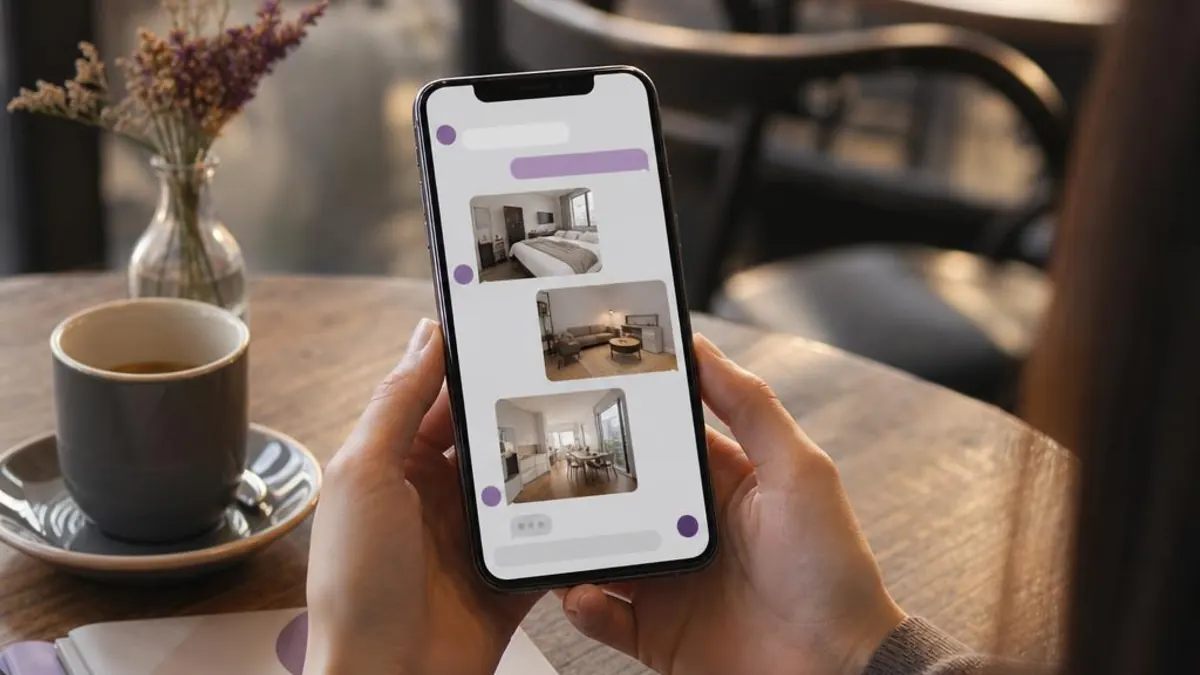
Until recently, artificial intelligence in travel mostly meant recommendations and automatically generated text. In 2026 it went a step further: it compares places to stay, checks availability and carries the booking through to payment. Google launched hotel booking in AI Mode, Airbnb introduced AI search, and some of the largest companies in travel published the first version of a standard that lets AI agents book rooms. Below you will find what has actually launched, where it is available, what is still unknown and what you can prepare now, as a host or property manager, so that your property is described accurately when an AI assistant recommends it.
What "agentic search" means
The term comes from "agentic AI": artificial intelligence systems that can complete a task in several steps, not just answer a question. In travel, the difference is easiest to see in three stages:
| Stage | What the traveller does | What the AI does | What matters for you |
|---|---|---|---|
| Classic search | Types a few keywords and opens links | Shows a list of results | Your position in the results, the main photo and the price shown |
| AI answers | Asks a question in their own words, for example "quiet apartment near the beach for a family with two children" | Summarises listings, reviews and web pages into a single answer | That your description and reviews contain the right information, which the AI can repeat |
| The AI agent | Describes the trip and confirms the booking | Compares options, checks price and availability in real time, fills in guest details and prepares the payment | That your property is connected to the channel the agent uses, with accurate prices and availability |
To be able to book, the agent needs a common language with booking systems. This is where protocols come in: UCP for commerce, covered below; MCP (Model Context Protocol), which connects AI assistants to external services; A2A, for communication between agents; and AP2, Google's protocol for agent-led payments. A host does not need to install any of them, but they explain why accommodation software providers have started talking about them.
The 2026 timeline: from announcements to the first bookings
| Date | What happened |
|---|---|
| 20 May 2026 | At the Google I/O conference, Google names hotels among the next areas UCP will cover. On the same day, Airbnb announces its Summer Release: AI-generated review highlights for guests and, for hosts, auto-replies, suggested actions and time-sensitive messages shown first. |
| Early August 2026 | Google confirms a limited test of agentic hotel booking in the US. The CEO of Booking Holdings, Booking.com's parent company, says a small percentage of Google's traffic already sees the feature and that his group is among the first partners. |
| 6 August 2026 | Airbnb reports that its AI assistant, available in more than 50 languages, resolves nearly 45% of the issues that start with it without a human agent. |
| 27 August 2026 | Google launches hotel booking in AI Mode, in the US and in English, with ten partners: Booking.com, Choice Hotels, Expedia, Hilton, Hotels.com, IHG, Marriott, Priceline, Trip.com and Wyndham. |
| 25 September 2026 | The UCP project publishes the first working draft of the lodging booking specification, open for public feedback on GitHub. |
| 30 September 2026 | Airbnb launches, starting in the US, AI search, AI filters, AI-generated descriptions in results and comparisons between saved homes. For hosts, it announces new tools "later this fall". |
Google: hotel booking directly in AI Mode
AI Mode is the conversational mode of Google Search: you ask a long question in your own words and get an answer built from several sources, with links. Since 27 August 2026, in the US, AI Mode can also complete the booking. The traveller describes the trip and their preferences, gets a visual list of hotels with guest reviews and the key factors for comparison, then selects "Continue on Google" next to one of the integrated partners. A few steps follow: room type, cancellation policy and payment through Google Pay. The hotel or booking platform remains the merchant of record and handles the customer relationship.
The launch was preceded by a limited test confirmed in early August. Glenn Fogel, CEO of Booking Holdings, said at the time that "a small percentage" of Google's traffic was seeing agentic booking and that his group was among the first partners. The list of partners announced on 27 August includes only hotel chains and online travel agencies.
What this means for Romania, now. Booking in AI Mode started in the US, in English, and Google has not announced a timeline for other countries. For the other travel features announced on the same day, Google states that flight price tracking is not available in the European Economic Area (EEA) and that some points and miles features will not be available to users in the EEA. For a host in Romania, the immediate effect is nil. The medium-term effect depends on the channels you sell through.
Hospitality.today notes that independent hotels are not among the partners and that, for now, they can reach Google's agent only through an intermediary: the online travel agency they already sell through or a global distribution system (GDS) such as Amadeus. Our interpretation: if the feature reaches Europe, an apartment listed on Booking.com or Expedia could appear through these platforms, not directly. However, Google has not said whether booking in AI Mode will include vacation rentals.
UCP: the standard that lets an AI agent book a room
The Universal Commerce Protocol (UCP) is an open standard for commerce through AI agents, published as an open-source project. On 25 September 2026, the first working draft of the lodging booking capability was merged into the project, shaped by seven companies: Amadeus, Booking.com, Expedia, Google, Hilton, Marriott and Trip.com. Google says it will use this standard for bookings in AI Mode "over the coming months", without giving a date.
Several rules from Google's documentation and the specification are relevant even for a small host:
| Question | What the sources say |
|---|---|
| Who is the seller? | The property or booking platform remains the merchant of record and keeps the customer relationship and the customer's data. |
| Does it affect ranking? | No. Google says the integration does not change how properties and rates are ranked; integrated offers only get the direct booking option. |
| What does the first stage cover? | Checking availability, previewing and completing a booking for a single room, with guest details, length of stay, payment schedule and special requirements. |
| Who confirms the booking? | In the default flow, the booking is completed by the traveller on a trusted screen. The agent prepares, the person confirms. |
| How is the price shown? | A single all-in total for the whole stay, shown before confirmation, including amounts paid at the property, such as local taxes. If the total changes along the way, the user must be warned. |
| What happens when the agent cannot continue? | The booking moves into an escalation state and the traveller is sent to the hotel's own interface. |
| Can you take part already? | Access is through a waitlist, and the specification is still a working draft that may change. |
For you, the message is simple: an AI agent compares totals, not base rates. If you show a low nightly rate and add the cleaning fee and other costs only at the end, the comparison will show the real price, just as the guest already sees it at checkout. The specification explicitly refers to US and EU price transparency rules.
Airbnb: AI in reviews, search and support
Airbnb has taken a different path from Google: not a chatbot that books for the traveller, but AI built into every step of the app. CEO Brian Chesky called the 30 September launch the company's "first foray" into AI search and said the feature would be improved quickly over the coming months.
| What launched | When and where | What it means for hosts |
|---|---|---|
| AI-generated highlights from reviews and the listing description, for example about location, amenities or whether a home is family-friendly | Summer Release, 20 May 2026 | Your reviews and description become the raw material of the summary, and recurring problems stand out. |
| Search ranking that favours higher-quality homes that fit each trip | Reported on 6 August 2026 | Quality, reflected in reviews among other things, matters for your position in results. |
| AI search, in your own words or by voice, and AI filters | 30 September 2026, starting in the US | Guests search by needs, for example "quiet" or "for babies", not just by city and dates. |
| AI-generated descriptions in search results and comparisons between saved homes | 30 September 2026, starting in the US | Your listing's strengths are automatically rephrased and placed next to those of other listings. |
| AI assistant for users, in more than 50 languages, with voice support in preparation | Reported on 6 August and 30 September 2026 | Platform support becomes faster and available in the guest's language; what you promise in your listing remains your responsibility. |
| For hosts: auto-replies to common questions, suggested actions and time-sensitive messages shown first | Announced on 20 May 2026 | You reply faster to simple questions. Check automatic texts before you turn them on. |
For hosts, Airbnb has announced for "later this fall" a shared calendar for multiple listings, 3D floor plans, dynamic pricing within a recommended range and AI performance insights with suggested actions. Seasonal settings and the new messaging tools are explained in our guide to the 2026 Summer Release for hosts.
What an AI reads about your property
Whether it is Airbnb's summaries, an answer in AI Mode or an agent comparing three apartments, the AI works with the information it finds. It does not see the apartment; it sees the description, photos, reviews, price and rules. The clearer and more consistent they are, the closer the summary will be to reality.
| Information | What to check |
|---|---|
| Description | Say concretely what the home offers: number of rooms and beds, how the beds are arranged, the floor and lift, parking, air conditioning, workspace. Avoid unsupported superlatives. |
| Amenities | Tick all the real amenities on the platform, and only those. When a guest uses a filter, for example for a cot, usually only listings with that amenity ticked appear. |
| Reviews | Read them the way an AI summary would: which themes repeat? Noise or a cleanliness problem mentioned by several guests will also appear in the summary. |
| Price | Check the total for a few typical stays, including the cleaning fee and other costs, not just the nightly rate. |
| Rules and cancellation | The same rules and the same cancellation terms on all channels, or differences you can explain. |
| Location | Real, measured distances to the beach, the centre, the train station or the airport. An agent comparing options will use exactly these figures. |
| Photos | Current photos of every room, with accurate captions. How to choose them and in what order to place them is explained in our guide to photos and descriptions. |
A six-step plan for the coming months
- Audit your channels. Open your listing on Airbnb, on Booking.com and on your own website, if you have one, and compare the name, address, capacity, amenities, rules and cancellation terms. Note any difference and fix it at the source, usually in your channel manager.
- Rewrite the description for guests' real questions. Think about how people search in their own words: "quiet apartment for a family with a baby, with parking, close to the beach". Your description should answer questions like these clearly, in simple sentences, without long lists of keywords.
- Work on the themes that repeat in reviews. Fix the problem, then reply publicly, briefly and concretely. Do not buy or invent reviews: the Omnibus Directive bans fake reviews. The steps are in our guide to reviews and reputation.
- Check the total, not just the nightly rate. Simulate three typical stays, for example a weekend, a week and a month, and look at the final amount the guest sees.
- If you have your own website, connect it properly. Google shows vacation rentals free of charge, and free booking links send visitors directly to your website, with no commission, but only through an integration partner that sends your rates, availability and photos. Google also has a structured data format for vacation rentals, but its guidelines are aimed at sites already working with a Google Technical Account Manager and with Hotel Center access. For a small host, the realistic route is the integration offered by the booking system provider. The full context is in our analysis of platform dependence and direct bookings.
- Ask your providers about agents. If you use a channel manager or a booking system, ask what plans it has for Google Vacation Rentals and for UCP. The answer tells you whether your property will be bookable without an intermediary when these features reach Europe.
What we don't know yet. There is no date for booking in AI Mode in Europe, nor for its move to UCP. We do not know whether vacation rentals will be included alongside hotels, nor when Airbnb's AI search and comparisons will reach Romania. Any offer that promises you "guaranteed visibility in AI" deserves caution: Google says explicitly that UCP integration does not affect ranking.
Risks and limits
- AI summaries can be wrong. A summary can highlight a problem solved long ago or generalise from a single review. Check regularly how your listing appears in the app and update the description when things change.
- Intermediaries stay at the centre. The large online travel agencies are among Google's first partners and help write the standard. AI agents can bring new bookings, but they do not automatically reduce your dependence on platforms.
- Guest data remains your responsibility. Whatever the channel a booking comes through, the same data protection rules apply, and you keep only the information you need.
- Platform rules still apply. Airbnb does not allow you to ask guests to pay outside the platform. Direct bookings are built through your own channels, not through Airbnb messages.
Where KeyBid helps
AI agents are changing how places to stay are found, but the basic decisions stay the same: what the property costs, what it can earn and at what price you offer it. For investors, the KeyBid ROI Calculator extension shows the estimated yield directly on sale listings on Storia, Imobiliare.ro and OLX, and the extension guide explains how to read it. If you already work with an AI assistant, you can also use the KeyBid assistant in ChatGPT: according to its public description, you paste a listing link or a screenshot and get a revenue projection, with the option of a PDF report. Like any automated estimate, the result is a starting point, not a guarantee.
For hosts and property managers, KeyBid Puls shows the prices of comparable listings in hexagonal zones with a 750 m radius, the events that influence demand and the impact of the weather over the next 7 days. A well-chosen price matters even more when an AI agent puts offers side by side.
Common mistakes
- Waiting for the "AI button" and doing nothing now. Agentic features will use the information you already have online. What you fix today will count when they reach Romania.
- Writing for the algorithm, not for the guest. Lists of keywords make reading harder and do not help an AI looking for clear answers to specific questions.
- Having different information on different channels. Different capacity, rules or cancellation terms on Airbnb, Booking.com and your website confuse guests and automated summaries.
- Showing a low rate and adding costs at the end. AI agents compare totals, and guests see the final amount before paying anyway.
- Ignoring themes that repeat in reviews. A problem mentioned by several guests ends up in the summary and appears in every comparison.
- Promising in your listing what you do not have. A summary built from reviews will reveal the gap between promise and reality.
Frequently asked questions
Can I already receive bookings through Google's AI Mode in Romania?
No, according to the public information available in mid-October 2026. Hotel booking in AI Mode started in the US, in English, with hotel chains and online agencies as partners, and Google has not announced a timeline for other countries. If your property is listed on Booking.com or Expedia, any future access could come through these platforms.
Do I need to sign up for the Universal Commerce Protocol?
Not directly. UCP is a standard for booking systems, platforms and agents, not a programme for individual hosts. Access is currently through a waitlist, and the lodging specification is still a working draft. The useful step for you is to ask your channel manager or booking system provider whether it plans to implement it.
Can Airbnb's AI summary misrepresent my listing?
It may emphasise things you do not consider important, because it starts from your description and your guests' reviews. The best protection is an accurate, up-to-date description, together with fixing the problems that appear in several reviews. Check your listing in the app regularly, the way a guest sees it.
Is a website of my own still worth it if bookings move to AI assistants?
Yes, as a source of complete, consistent information and as a channel you control. Through Google's free booking links, a website connected through an integration partner can receive visitors directly from search. What such a website should include is explained in our guide to your own website for direct bookings.
Sources
- Google – 3 new ways to plan and book travel in Search (27 August 2026)
- Google for Developers – Universal Commerce Protocol (UCP) for Lodging: Frequently Asked Questions
- GitHub – Universal Commerce Protocol
- Relevant Audience – Google to power AI Mode hotel booking with the new UCP lodging draft (29 September 2026)
- Hospitality.today – Google moves hotel bookings into the agentic commerce era (20 May 2026)
- Hospitality.today – Google just put agentic hotel booking into testing (10 August 2026)
- Airbnb Newsroom – Airbnb 2026 Summer Release (20 May 2026)
- Airbnb Community – Home hosts: Airbnb’s 2026 Summer Release is here (20 May 2026)
- Airbnb Newsroom – Airbnb Q2 2026 financial results (6 August 2026)
- Airbnb Newsroom – Airbnb 2026 fall update (30 September 2026)
- TechCrunch – Airbnb adds AI search, more social features (30 September 2026)
- Google – About vacation rentals on Google
- Google – Connect with more travelers using free booking links
- Google Search Central – Vacation rental (VacationRental) structured data
- Airbnb Help Center – Off-Platform and Fee Transparency Policy
- EUR-Lex – Directive (EU) 2019/2161 of the European Parliament and of the Council of 27 November 2019 (Omnibus Directive)
- KeyBid – the KeyBid assistant in ChatGPT, public description (accessed 12 October 2026)